If you're searching for the best EDC multitool for flight attendants that can ride safely in your checked bag and stay TSA compliant, the short answer is this: you want a full-size pliers-based multitool with a blade under 2.36 inches (6 cm) measured from the pivot, no fixed or assisted-opening locking blade marketed as tactical, and a slim profile that survives baggage handling. Multitools belong in checked luggage only — never your crew tote in the cabin — and the smartest picks balance pliers, scissors, screwdrivers, a bottle opener, and a short knife that clears layered rules across U.S., EU, U.K., and Asia-Pacific hubs you actually layover in.
Flight attendants live a very particular EDC life. You bid trips months out, rotate between domestic turns and international long-hauls, and your kit has to function in a Marriott bathroom in Frankfurt as easily as in a galley over Kansas. Crew also face a paradox the average traveler doesn't: TSA's PreCheck program for known crewmembers (KCM) does not change the prohibited items list. Knives, scissors over 4 inches from the pivot, and most multitools still cannot ride in your cabin bag. That's why the question isn't "which multitool is allowed through security" — it's "which multitool is the best EDC multitool for flight attendants to pack in the checked roller and rely on at the layover hotel."
TSA, ICAO, and EASA Rules Crew Actually Need to Know
TSA rules are the floor, not the ceiling. If your flight loops through Heathrow, Frankfurt, Narita, or Dubai, you are subject to the rules of whoever screens your bag last before it loads. Here is the practical compliance summary for 2026:
- U.S. TSA (checked bag): Knives of any length are allowed in checked luggage if sheathed or wrapped. Multitools with blades are permitted in checked only.
- U.S. TSA (carry-on): Multitools with blades are prohibited. Multitools without any blade (pliers-only, screwdriver-only) under 7 inches are technically allowed in carry-on, but enforcement is inconsistent — do not risk it on a working trip.
- EU / EASA: Blades over 6 cm (2.36 inches) are prohibited even in checked when carried by crew through staff screening at some bases. Stay under that number.
- U.K. CAA: Mirrors EU rules; scissors with rounded tips fare better at LHR and LGW staff screening than pointed shears.
- Australia and Singapore: Strict on "flick knives" and assisted-opening mechanisms. Choose a manual nail-nick or thumb-stud opener, never a spring assist.
The takeaway: the best EDC multitool for flight attendants is one with a blade at or under 2.36 inches, manual opening, no glass breaker or seatbelt cutter (those read as "tactical" to screeners), and a finish that doesn't scream weapon.
What to Look For in a Crew-Friendly Multitool
Pliers That Actually Work
Full-size pliers handle the small disasters of crew life: bending a stuck zipper pull on a Tumi, gripping a stripped screw on a hotel curtain rod, pulling a snapped guitar string for the layover acoustic set. Look for needle-nose with built-in wire cutters and replaceable cutter inserts. Spring-loaded pliers reduce hand fatigue after a 14-hour duty day. Stub-nose pliers are stronger but worse in tight spaces — needle-nose wins for cabin use.
Scissors Over a Long Blade
This is the single most important takeaway for crew. A good scissors will do 90% of what crew actually need a multitool for — trimming loose threads on a uniform, snipping a hangnail, cutting tape and cardboard at outstations, opening blister packs of replacement compression socks. Prioritize scissors quality over blade quality. The Leatherman scissors on the Wave+ and Charge+ are the gold standard. Victorinox SwissTool scissors are sharper but smaller.
A Short, Boring Blade
You want the most uninteresting blade possible. Plain edge, drop point, satin finish, under 2.36 inches. Avoid serrations (harder to sharpen, looks aggressive), black-coated blades (reads tactical), and partial-serration blades. A 420HC stainless blade is plenty for crew tasks and resists corrosion in humid layover climates like Singapore and Bangkok.
Bit Drivers and Screwdrivers
Hotel rooms are not built well. A Phillips #1 and a small flathead will save you on dozens of trips — tightening loose door hardware, fixing a wobbly rolling-bag handle, opening a battery compartment on a remote. A bit driver with a small kit of replaceable bits is more versatile than dedicated drivers, but bit kits add bulk to your already-stuffed roller.
The Boring Stuff That Matters
Bottle opener, can opener, tweezers, and a tiny file. None of these are exciting, but a bottle opener on the line at a Lisbon crew dinner and tweezers for a splinter at 35,000 feet are the moments multitools earn their keep. Our deeper breakdown of essential multitool features walks through which of these are worth the weight and which are dead grams.
Top Multitool Categories for Flight Attendants in 2026
The Full-Size Workhorse: Leatherman Wave+ Style
If you only buy one multitool for your entire flying career, this is the category. A full-size pliers-based multitool with scissors, two outside-opening blades (one plain, one serrated — leave the serrated unopened in your bag), a saw, file, can opener, bottle opener, and four screwdrivers in roughly 8.5 oz. The Wave+ specifically uses a 2.9-inch blade that exceeds the strict EU 6 cm rule, so European-base crew should check our Leatherman Wave+ deep-dive review and consider the smaller Skeletool or Free P2 instead. For a fuller breakdown of how this category stacks up against the competition, see our 2026 top multitools roundup.
The Lightweight Layover Pick: Skeletool or Free T2
If you fly narrowbody and your checked allowance is already crushed by uniform pieces and hotel-room shoes, a lightweight multitool earns its slot. The Skeletool weighs about 5 oz, has pliers, wire cutters, a 2.6-inch blade, a bit driver, and a carabiner/bottle opener. The Free T2 ditches pliers entirely for scissors and a blade in a 3 oz package — closer to a Swiss Army knife than a multitool, but featherweight. International crew will appreciate that the Free T2's blade comes in at 2.2 inches, comfortably under the EU 2.36-inch threshold.
The Swiss Army Alternative: Victorinox SwissTool Spirit X
For long-haul crew who do longer slips in regulated jurisdictions, the SwissTool Spirit X is the quiet champion. All tools open from the outside, the build quality is exceptional, the scissors are surgical, and the satin finish reads "office supply" to a baggage screener. The blade is 2.6 inches, which still exceeds the EU rule, but most enforcement is at the cabin, not the checked bag. Compare it head to head in our Wave+ vs SwissTool comparison before you commit.
The Budget Pick: Gerber Suspension NXT
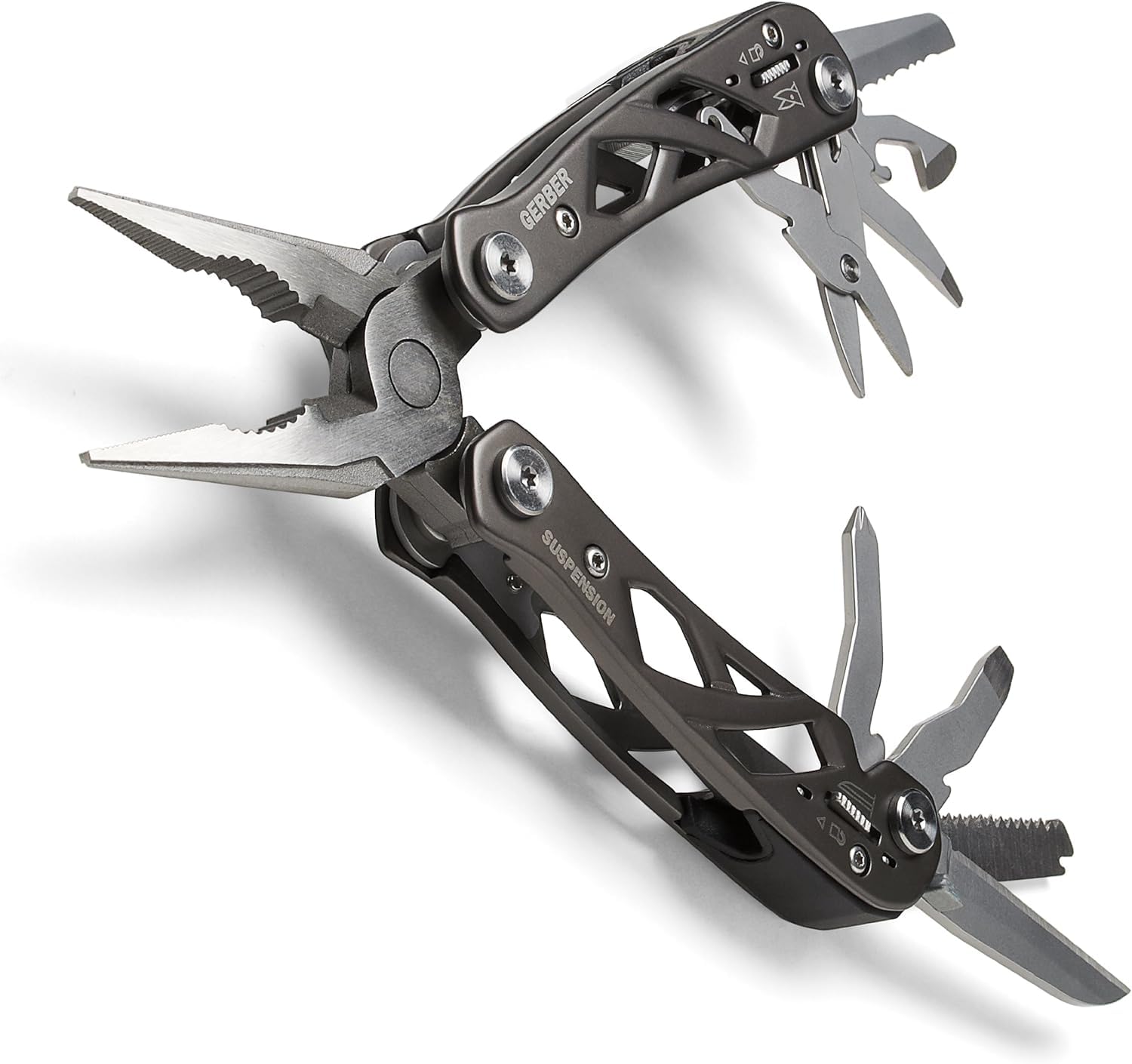
Probationary first-year FAs on reserve pay should not spend $130 on a multitool. The Gerber Suspension NXT runs about $25, weighs 5.5 oz, has 15 tools including spring-loaded pliers, scissors, and a 2.17-inch blade that clears every international rule we checked. The build is not Leatherman-tier and the bit driver isn't there, but for crew tasks it punches well above its weight. We list more affordable options in our 2026 budget multitool guide.
How to Pack Your Multitool for Checked-Bag Compliance
TSA's published rule is that sharp objects in checked bags must be "sheathed or securely wrapped to prevent injury to baggage handlers and inspectors." In practice, this is enforced loosely on the U.S. side and strictly in Asia. Here is the workflow that survives every screening point:
- Multitool goes inside its included nylon or leather sheath.
- Sheath goes inside a hard-sided eyeglass case or small Pelican micro case.
- Case goes inside your packing cube of "non-uniform tools" — chargers, sleep mask, etc. — not loose in the roller liner.
- The packing cube goes in the bottom of the rolling suitcase, not the top exterior pocket.
This protects the tool from the handlers, the handlers from the tool, and your screening time from a baggage inspection note. Keep your bag's TSA-approved lock combination written somewhere accessible — if a screener does open the bag, they'll re-lock it, but if you used a non-TSA lock they'll cut it. For a more general packing system that works around a checked multitool, our pro-level EDC kit packing guide is the next read.
What NOT to Carry as a Flight Attendant
- Anything marketed as "tactical" or "survival." Black-coated multitools with glass breakers and seatbelt cutters are an instant secondary screening flag in most non-U.S. jurisdictions.
- Assisted-opening or automatic knives. Even in checked, these are restricted or banned in Germany, Australia, and Singapore.
- Fixed-blade knives of any size. They're legal in U.S. checked but flagged everywhere else.
- Wave+ class tools through Middle Eastern bases. Some carriers' crew bag policies are stricter than the country's airport rules. Read your own carrier's IFM before you pack.
Frequently Asked Questions
Can flight attendants carry a multitool in their cabin tote?
No. Despite Known Crewmember (KCM) screening, the prohibited items list still applies, and multitools with blades are explicitly banned in cabin baggage by TSA, EASA, and CAA. A pliers-only multitool with no blade is technically allowed under TSA rules if under 7 inches, but enforcement is inconsistent and you risk losing the tool. Always check it.
What is the best TSA-approved multitool for flight crew checked bags?
For most U.S.-based crew, the Leatherman Wave+ is the highest-rated TSA-compliant checked-bag multitool because of its scissors, full bit driver, and outside-opening blades. For crew flying through EU and U.K. bases regularly, the Leatherman Free T2 or Victorinox SwissTool Spirit X with sub-2.5-inch blades cut down enforcement risk on the rare baggage inspection.
What multitool blade length is safe for international flight attendant travel?
Stay at or below 2.36 inches (6 cm) measured from the pivot to the tip. That length clears EU, U.K., Australian, and Japanese rules for checked baggage in every jurisdiction we surveyed for 2026. Even where longer blades are technically legal in checked, a sub-2.36-inch blade reduces the chance of a manual bag inspection delay.
Are Leatherman multitools allowed in flight attendant checked luggage?
Yes, every Leatherman model is allowed in checked luggage under TSA rules as long as the blade is sheathed or wrapped. Leatherman's Wave+, Charge+, Skeletool, Free P2, Free P4, and Free T2 are the most common picks among working crew. The Wave+ and Charge+ are slightly oversized for EU bases due to a 2.9-inch blade.
Can flight attendants carry small scissors on board?
TSA permits scissors with blades shorter than 4 inches measured from the pivot in carry-on bags. EU and U.K. rules cap scissor blades at 6 cm. So a small standalone scissors — like the one on a Victorinox Classic SD keychain knife — is fine in your cabin tote in most jurisdictions, but the scissors on a full multitool count as part of a prohibited multitool.
What is the lightest multitool for flight attendant EDC?
The Leatherman Free T2 at 3 oz is the lightest credible multitool for crew use — scissors, blade, file, tweezers, screwdriver. It has no pliers, which is the tradeoff. For a pliers-equipped option, the Skeletool at 5 oz is the lightest full multitool. Our 2026 lightweight multitool guide ranks more sub-6-oz options.
How do I keep my multitool from rusting after international layovers?
Humid hubs like Singapore, Bangkok, and Miami eat carbon steel for breakfast. Use a multitool with 420HC, 154CM, or similar stainless steel. After any layover above 80% humidity, wipe the tool dry, open every implement, and put a drop of mineral oil or Tuf-Glide on each pivot. Store the tool in its sheath rather than loose, and never leave it in a damp bathroom kit.
Should I declare my multitool when checking my crew bag?
No declaration is required for a TSA-compliant multitool in checked baggage. It is, however, smart to keep it accessible to TSA inspectors — top of a packing cube, not buried under a uniform jacket — so that if your bag is opened, the inspector can confirm and re-pack without forcing a hand search of every layer.
Key Takeaways
- Choosing the right best EDC multitool for flight attendants means matching capacity and output ports to your actual devices
- Always check actual watt-hours (Wh), not just watts — runtime depends on Wh, not peak output
- Also covers: flight attendant checked bag multitool
- Also covers: TSA compliant multitool crew layover
- Also covers: flight attendant EDC kit hotel
- Compare price-per-Wh across models to find the best value for your budget