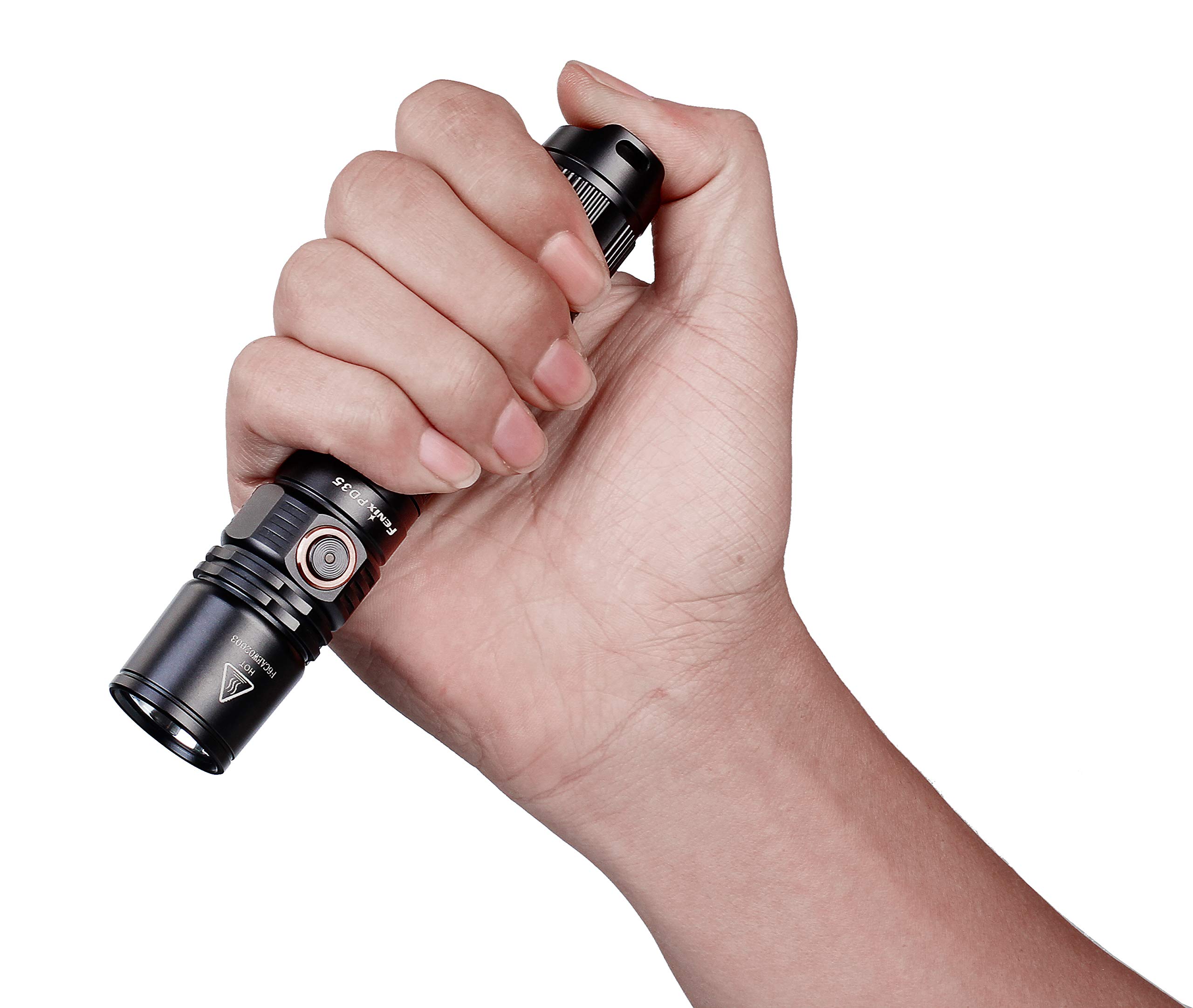
The Fenix PD35 V3 for night shift security guards working in sub-freezing conditions is one of the most reliable tactical flashlight choices on the market today. With a maximum output of 1,700 lumens, a beam throw of 357 meters, an IP68 waterproof rating, and a body machined from aerospace-grade aluminum, this light is built to survive long, cold patrols where dependability matters more than gimmicks. For overnight guards walking warehouse perimeters, parking structures, construction sites, or remote industrial yards in winter, the PD35 V3 delivers fast strobe access, glove-friendly controls, and battery flexibility that keeps you operational when temperatures drop well below freezing.
This buyer's guide breaks down exactly why the PD35 V3 has become a go-to for cold-weather security work, what to watch out for when running it in sub-zero conditions, and how to set it up for a 10-12 hour shift without losing brightness when you need it most.
When shopping for Fenix PD35 V3 for night shift security guards, it pays to compare specs, capacity, and real-world runtime before committing.
As an Amazon Associate we earn from qualifying purchases.
Why the Fenix PD35 V3 Works for Cold-Weather Night Shift Security
Security work in winter is a unique torture test for a flashlight. You are outdoors for hours, gloves are thick, batteries chill quickly, and any failure means you are checking a dark stairwell with a phone screen. The PD35 V3 was designed with that exact scenario in mind, and several of its design choices map directly onto cold-weather patrol requirements.
First, the dual-switch interface is one of the best in the tactical category. A rear tactical tail switch handles momentary-on and constant-on, while a side switch cycles through five output modes (Eco, Low, Medium, High, Turbo) plus a dedicated strobe. With heavy winter gloves, you do not want to fumble through a touch interface or rotary head ring — the tactile click of a metal tail cap is unbeatable.
Second, the body uses a knurled aluminum grip with deep, aggressive texturing. When your hands are numb or wet from snow, that grip pattern keeps the light secure. Pair it with the included two-way pocket clip and you can reverse-mount it bezel-down on a duty belt or chest rig for fast deployment.
Third, the IP68 rating means the light survives full submersion to two meters. For a guard caught in freezing rain, sleet, or knee-deep slush around a loading dock, that matters. The PD35 V3 is also impact-rated to 1 meter, which is realistic for the inevitable drop on concrete during a shift change.
Cold-Weather Battery Strategy: The Real Bottleneck
The single biggest issue cold-weather guards face is not the flashlight itself — it is the battery. The PD35 V3 ships ready to run on a 21700 or 18650 lithium-ion rechargeable, but it also accepts two CR123A primary lithium cells. This dual-fuel capability is the most overlooked feature for sub-zero work.
Lithium-ion rechargeables (18650 or 21700) lose significant capacity below freezing. At -10°C, you can expect 60-70% of rated runtime. At -20°C, performance falls off a cliff and the protection circuit may shut the cell down entirely. CR123A primary lithium cells, by contrast, are rated to perform reliably down to -40°C and have a 10-year shelf life. For winter shifts, the smart move is to carry your rechargeable as your daily driver and keep two CR123A cells in a sealed pocket inside your jacket as a backup.
Another tip: keep your spare 18650 in an inner jacket pocket, not in a belt pouch. Body heat keeps the cell within its happy operating range. When you swap, the warm battery will deliver near full output even if the outside temperature is brutal. For more on extending runtime, see our detailed guide on maximizing flashlight battery life.
Output Modes That Actually Match Patrol Reality
The PD35 V3's five output levels are well chosen for security work, and matching the mode to the task extends both runtime and your situational awareness.
- Eco (30 lumens, 80 hours): Reading paperwork at a guard shack, checking ID badges, walking a familiar interior corridor. This is your default for low-stimulus tasks where you do not want to blow out your night-adapted vision.
- Low (150 lumens, 22 hours): Indoor patrol of a warehouse, checking storage racks, looking under vehicles in a parking deck.
- Medium (350 lumens, 6 hours): Outdoor perimeter walks where you need usable throw without burning runtime.
- High (1000 lumens, 2 hours 50 minutes): Searching a wooded fence line, sweeping a large loading yard, or confirming activity at the edge of your property.
- Turbo (1700 lumens, 2 hours 15 minutes with step-down): Identifying threats or vehicles at maximum range. Note that turbo steps down after ~3 minutes to protect the LED and your hand from heat.
- Strobe (1700 lumens): Disorientation tool, accessed instantly from the tail switch via double-tap, even in tactical mode lockout.
For most cold-weather shifts, you will live in Low and Medium and only spike to High when investigating something specific. This is what makes the dual-switch interface so important — you can preset the side switch to your preferred patrol mode and use the tail switch as a momentary on/off without changing settings.
Carry Setup for a 10-12 Hour Winter Shift
The PD35 V3 measures 5.59 inches long and weighs about 3.1 ounces without the battery. It is just barely pocket-sized for a uniform pants pocket, but most working guards prefer a Kydex holster or nylon belt pouch. The included clip is sturdy enough for shirt-pocket carry on indoor shifts, but for outdoor winter work the belt pouch with a hook-and-loop flap is more secure when you are getting in and out of a patrol vehicle.
A useful kit-out for cold-weather guards: PD35 V3 in a belt holster on your strong side, two CR123A primaries in a sealed inner pocket, a spare charged 18650 in an inner jacket pocket, and a backup penlight on your chest rig for close work like reading meter panels. For a deeper look at structuring an effective carry loadout, our guide on how to pack and organize an EDC kit walks through prioritizing tools by frequency of use.
Featured Pick: Fenix PD35 V3 Tactical Flashlight
Fenix PD35 V3 (1700 Lumens, Dual Switch)
The PD35 V3 is the clear category leader for cold-weather security work because of its combination of dual-fuel capability, glove-friendly dual switches, IP68 waterproofing, and 357-meter throw. The Luminus SST70 LED produces a balanced beam with enough hotspot for distance identification and enough spill for close-range room clearing. The aluminum body resists corrosion from road salt, and the bezel is crenelated for emergency glass-break use. For night shift guards working winter patrols in industrial, retail, or campus environments, this is the most reliable flashlight you can put on a duty belt under $120. Read our full breakdown in our Fenix PD35 V3 review.
What to Look for in a Cold-Weather Security Flashlight
If you are evaluating alternatives or building a backup, these are the non-negotiable specs for sub-zero security work:
- Dual-fuel battery support: CR123A compatibility is the difference between a working light at -25°C and a paperweight. Lithium-ion only is a liability in deep cold.
- Physical switches, not capacitive touch: Touch sensors fail under wet gloves and can misread frozen fingers.
- IP68 or better: Sleet, snow, and ice melt are constants on winter patrol.
- Knurled grip: Smooth bodies become slick when wet or cold-numbed.
- Multi-mode with a true low: Sub-50 lumen modes preserve night vision and extend runtime.
- Direct strobe access: For de-escalation and disorientation in confrontations.
- Reverse polarity protection: Critical when swapping cold batteries with gloved hands in low light.
If you want to compare other proven options against the PD35 V3, see our guide on the best tactical flashlights for everyday carry.
Maintenance Routine for Cold-Weather Use
Winter is hard on flashlights in ways most users never see. Salt, ice melt, and condensation work their way into threads, O-rings, and switch boots. A weekly maintenance routine keeps your PD35 V3 running for the full life of the LED (50,000 hours rated):
- Unscrew the tail cap and head, wipe the threads with a dry microfiber cloth.
- Inspect the two O-rings for cuts, flat spots, or grit. Replace annually or sooner if compromised.
- Apply a thin film of silicone grease (not petroleum-based — it degrades rubber) to the threads and O-rings.
- Clean the battery contacts with a pencil eraser to remove any oxidation.
- Cycle the light through all modes to confirm the side switch and tail switch both feel crisp.
For a more complete schedule, our EDC flashlight maintenance guide covers seasonal service and storage practices.
Real-World Limitations to Know
The PD35 V3 is not perfect, and honest disclosure matters. Three things to know before you commit:
Heat step-down on Turbo: After roughly 3 minutes at 1700 lumens, the light steps down to about 500 lumens to protect the LED. This is industry standard but worth knowing if you were planning to use Turbo as a continuous patrol mode. Do not — use High instead.
No built-in USB charging: Unlike some competitors, the PD35 V3 requires an external battery charger. For most security teams this is fine because you charge between shifts, but it adds one more piece of kit to manage.
Battery not included: The light ships with a holster and lanyard but no cell. Budget for a quality protected 21700 or 18650 from a reputable brand, plus a four-bay charger for your spares.
Frequently Asked Questions
Can the Fenix PD35 V3 actually handle sub-zero temperatures during long winter patrols?
Yes. The aluminum body, electronics, and switches are rated for operation down to -20°C, and the limiting factor is the battery rather than the light itself. Using CR123A primary lithium cells extends reliable operation down to -40°C, which covers virtually any North American winter security environment.
How long will the Fenix PD35 V3 run on a single 18650 during a 12-hour night shift?
If you primarily run Eco and Low modes with occasional Medium use for outdoor sweeps, a fully charged 3500mAh 18650 will easily last a 12-hour shift with 30-50% capacity to spare at room temperature. In cold weather, plan on 60-70% of that runtime and carry a charged spare in an inner pocket.
Is the strobe mode bright enough to disorient a hostile subject at close range?
Yes. At 1700 lumens with a high-frequency strobe pattern, the PD35 V3 produces measurable disorientation at distances under 5 meters. It is accessible via a double-tap of the tail switch from any state, which is critical when you do not have time to fumble through menus.
Should I use rechargeable 18650s or 21700s in the Fenix PD35 V3 for security work?
The 21700 delivers more capacity (typically 5000mAh vs 3500mAh) and slightly better cold-weather performance due to greater thermal mass. If you can fit the larger battery in your carry setup, the 21700 is the better choice. The light ships with a battery sleeve to accommodate the slimmer 18650 if you prefer it.
Is the PD35 V3 better than the Olight Warrior or Streamlight ProTac for cold-weather guard work?
For pure cold-weather reliability, the PD35 V3 edges out competitors because of its dual-fuel CR123A compatibility, robust physical switches, and proven Fenix durability. Olight lights often use proprietary magnetic charging that can be finicky in extreme cold, and many Streamlight tactical models lack the multi-mode flexibility for long patrols. See our comparison of the Olight S2R Baton II vs Fenix PD35 for a head-to-head breakdown.
How should I carry the Fenix PD35 V3 on a security guard uniform?
A Kydex or nylon belt holster on your support side is the most secure carry, with the bezel oriented down for fast draw. Avoid pocket carry alone in winter — the deep, gloved-hand access is slow and the clip can snag on coat hems. A chest rig mount on a duty vest is the second-best option for guards working in vehicles where belt carry interferes with seatbelts.
What is the warranty on the Fenix PD35 V3 and does it cover heavy professional use?
Fenix offers a 5-year limited warranty on the PD35 V3, with a 15-day no-questions replacement and lifetime free repair for manufacturing defects. The warranty covers normal professional use, including security and law enforcement applications. Damage from disassembly, water intrusion due to a missing O-ring, or third-party battery defects is not covered.
For ongoing reading on building out the rest of your kit, our overview of top features to look for in EDC gear covers what separates professional-grade tools from consumer-tier alternatives.
Key Takeaways
- Choosing the right Fenix PD35 V3 for night shift security guards means matching the key features to your specific needs and budget
- Read real customer reviews and check the return policy before you commit
- Also covers: Fenix PD35 V3 cold weather performance
- Also covers: best flashlight for overnight security patrol
- Also covers: Fenix PD35 V3 battery life cold
- Compare value across models — the priciest option is not always the best fit